
1. The Innovator’s Playground
Perched on the jagged cliffs of La Jolla, where the unrelenting Pacific shoreline meets a skyline of concrete and glass, the University of California San Diego presents a striking architectural paradox. To the casual observer, it is a scenic masterpiece of the Southern California coast; to the academic, it is a “fearless innovator” defined by a compulsive urge to take the world apart and reconstruct it in surprising ways. Beneath its famed “brutalist-futurist” aesthetic lies a history not of traditional collegiate growth, but of radical experimentation. UC San Diego was never meant to be just another university; it was designed as a bold risk, a place where futuristic architecture serves as the shell for a culture of rigorous, high-stakes research.
2. The Graduate-First Genesis
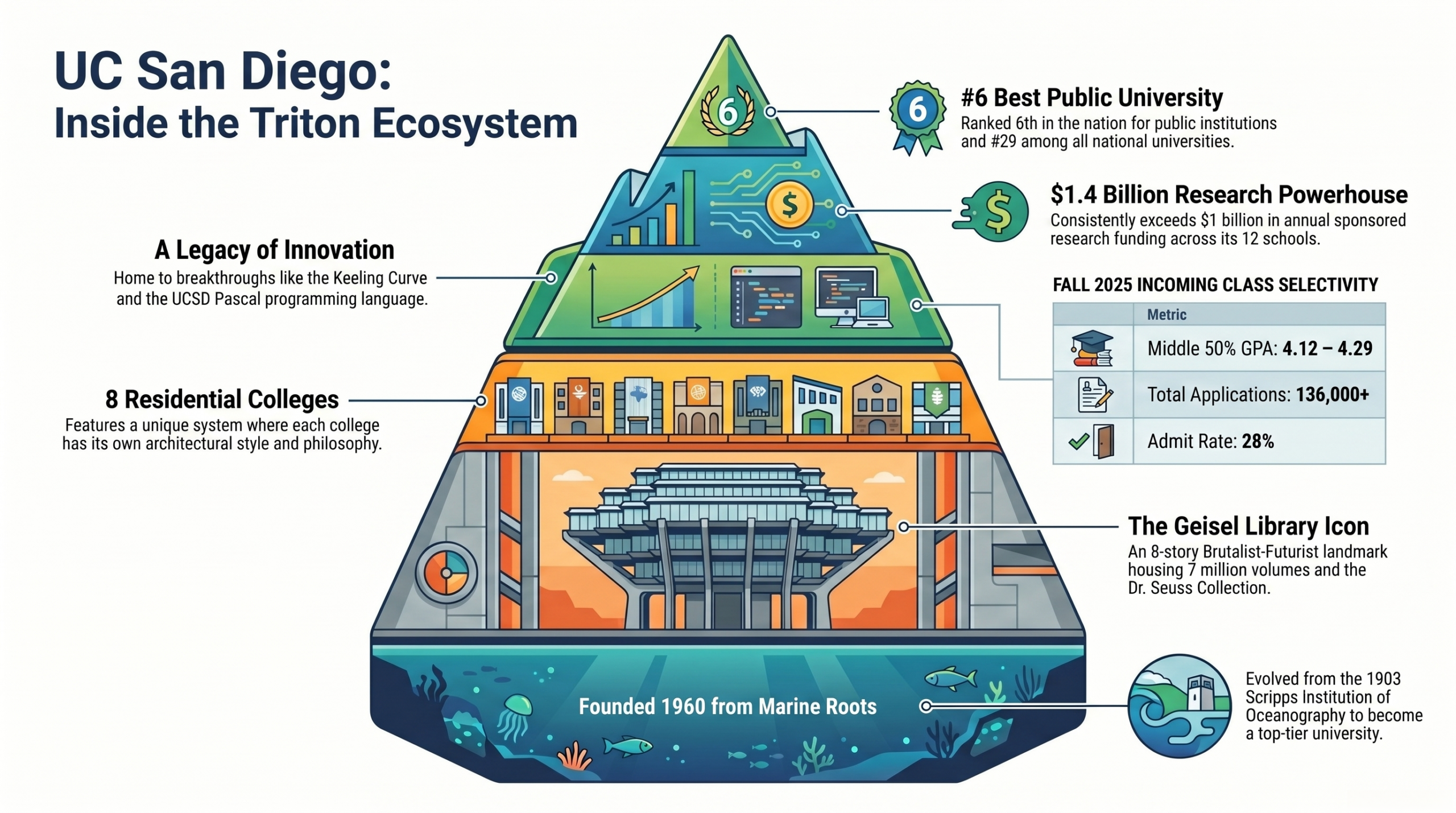
While most American universities grow “bottom-up” from undergraduate roots, UC San Diego was a “top-down” creation. Its true nucleus was the Scripps Institution of Oceanography, a research station that had operated in relative isolation for fifty years before the university’s official founding in 1960. Roger Revelle, the university’s visionary “father,” initially ignored the traditional undergraduate model entirely. He envisioned a “Caltech of the West”—a graduate-only powerhouse focused exclusively on science and technology.
This elitist vision faced fierce resistance. Internal UC politics and Revelle’s own “tactless” handling of local affairs—including a bitter public dispute with Jonas Salk over the location of the Salk Institute—eventually cost him the chancellorship. While Revelle famously promised the school would have “no football team” and a faculty-to-student ratio of 1 to 3.2 (dramatically lower than the system-wide 1 to 15), the UC Regents ultimately appointed Herbert York as the first Chancellor to steer the ship toward a more comprehensive model. Yet, the high-level scientific mission remained clear. As UC President Robert Gordon Sproul declared:
“Our industrial civilization and our very survival as a country depend critically on increasing the number of able young scientists.”
3. The Mystery of the “Missing” Third Floor
The Geisel Library is a fascinating nexus of design, featuring cantilevered stories that fan out like reinforced concrete “hands” holding up a stack of books. This gravity-defying silhouette birthed one of the most persistent urban legends in academia: the myth of the “missing” third floor. Students have long whispered that the building’s architects failed to account for the weight of the books, leaving the third floor sealed off to prevent a structural collapse.
The truth is found in the architectural intent of William Pereira. The “missing” floor is actually the open-air outdoor forum, a concrete platform designed for sculpture displays and acoustic music. The myth of “unsupported weight” likely persists because of the visual tension of the cantilevered upper floors. In reality, the library even includes a hidden level—floor “3.5”—which houses utility connections and wiring, tucked away from the public gaze and the legendary “empty” space of the forum.
4. A Physics Experiment That Became a Tradition
UC San Diego’s oldest tradition, the “Watermelon Drop,” is perhaps the ultimate synthesis of campus culture and scientific rigor. Born in 1965 as a question on a physics exam, the event asked students to calculate the terminal velocity and impact force of a watermelon dropped from the 7th floor of Urey Hall.
The students didn’t just solve the equation on paper; they took to the roof. This tradition reflects the measurement-heavy spirit of the era—a time when faculty like Charles David Keeling were establishing the “Keeling Curve” to track atmospheric CO2. Today, the drop is a festival complete with a “Watermelon Queen” and a precise measurement of the “splat” distance. It serves as a yearly reminder that at UC San Diego, even the most whimsical traditions are rooted in the university’s founding obsession with data and measurement.
5. The Oxbridge Model in Southern California
Defying the monolithic structure of the typical American “mega-university,” UC San Diego utilizes a unique “college-within-a-university” system inspired by the Oxbridge models of Oxford and Cambridge. The campus is divided into eight residential colleges, each functioning as its own community with distinct general education requirements and philosophical themes.
This structure allows students to enjoy the resources of a top-tier research institution while finding a home in a smaller, specialized environment. The diversity of these philosophies is vast:
- Revelle College: Maintains a “Renaissance education” via a highly structured Humanities sequence.
- John Muir College: Promotes a “spirit of self-sufficiency” with flexible, student-led curriculum choices.
- Seventh College: Focuses on “A Changing Planet” and environmental sustainability.
- Eighth College: The newest addition, centered on the theme of “Engagement & Community” to solve local and global issues.
6. The Fragile Legacy of Dr. Seuss
In 1995, the university’s central library was renamed to honor Audrey and Theodor Seuss Geisel. While the building is a monument to the whimsy of Dr. Seuss, the archives within the Mandeville Special Collections are treated with solemn care. The Dr. Seuss Collection contains approximately 8,500 items, from high school sketches to final manuscripts, documenting Geisel’s creative life from 1919 to 1991.
However, the collection is considered “too fragile” for the general public; access is strictly reserved for researchers who secure permission from the Director of Special Collections. This archive is also a site of rigorous academic honesty. The university archives his full range, including early work that has faced modern criticism for “anti-Blackness” and “Orientalism.” By preserving these items, the university maintains a complete historical record of Geisel’s evolution and the complexities of his creative legacy.
7. Snakes, Fallen Stars, and Hidden Art
Public art at UC San Diego is not merely decorative; it is an intellectual journey curated by the Stuart Collection. The Snake Path, a 560-foot winding slate tile walkway, serves as a literal and symbolic bridge between the lower campus and the “Tree of Knowledge”—the library. The path winds through a small garden of fruit trees, passing a giant granite representation of Milton’s Paradise Lost. The book is engraved with a poignant reminder of the journey of learning:
“Then Wilt Thou Not Be Loth To Leave This Paradis But Shall Possess A Paradise Within Thee, Happier Far.”
Nearby, the collection challenges the very laws of domesticity with Fallen Star, a fully furnished house sitting precariously atop the Jacobs School of Engineering. This installation, appearing to have “landed” on the edge of a seven-story building, forces a dialogue about home, displacement, and the literal “edge” of innovation that defines the campus.
8. The “Edge of Tomorrow” Legacy
From its start as a remote oceanographic field station to its current standing as the #6 public university in the nation, UC San Diego has consistently pushed the “edge of tomorrow.” Its impact on the modern world is seen in the “ancestry” of our technology; researchers here developed UCSD Pascal, an early machine-independent programming language that served as a primary influence for the development of Java.
As the university expands through its “Living and Learning Neighborhoods,” it remains a testament to the power of the experimental. In an era of increasingly standardized higher education, one must ask: Does UC San Diego’s model of specialized, small-college communities within a massive research engine provide the ultimate blueprint for the future of the American university?