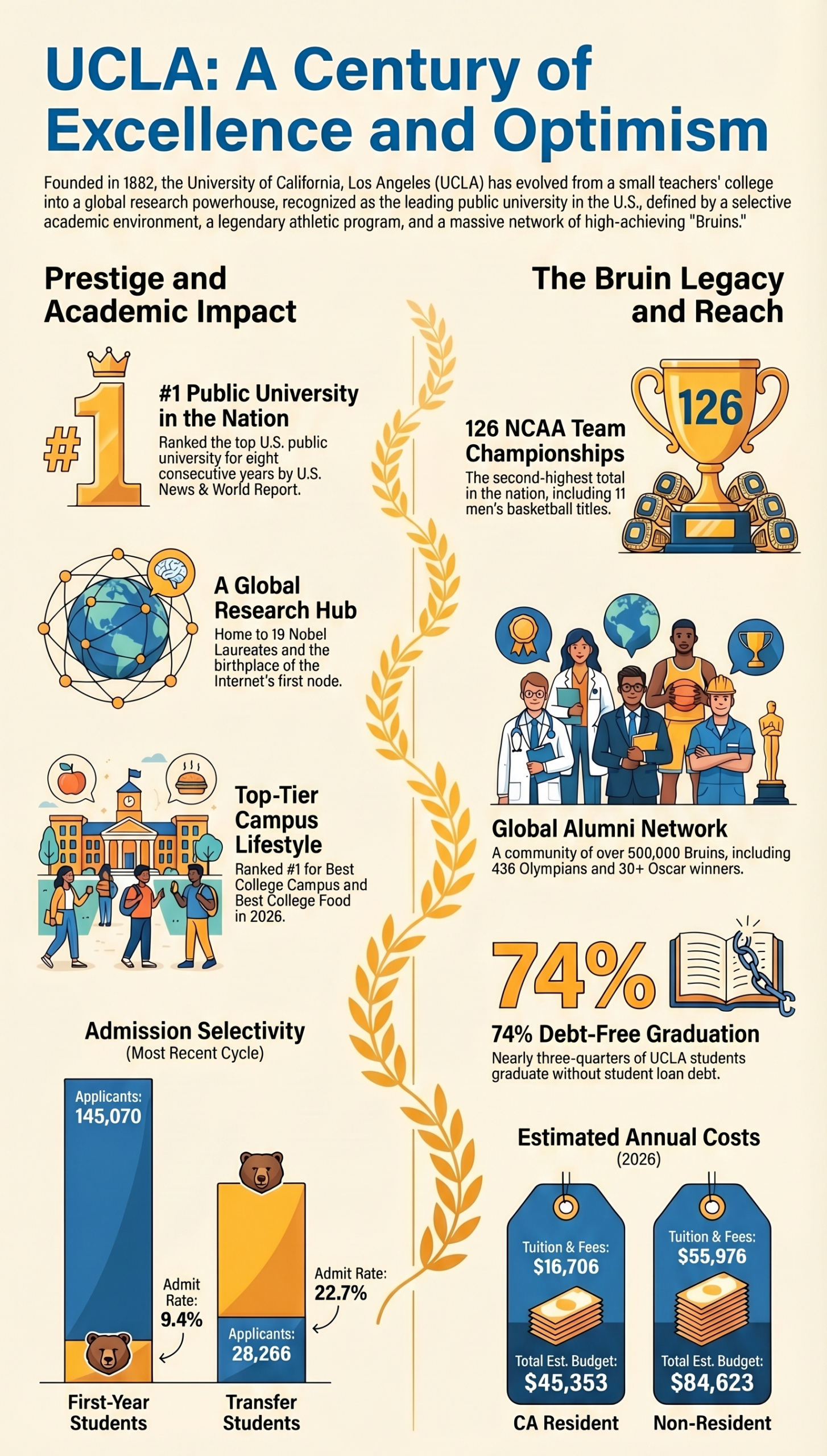
Every year, the University of California, Los Angeles (UCLA) earns a singular distinction: it is the most applied-to university in the United States. For the most recent cycle, over 145,000 hopeful students vied for a spot in the freshman class, drawn by a prestige that feels both quintessentially Californian and globally dominant. While its reputation is well-known, the sheer volume of interest raises a compelling question: what is it about this institution that captures the global imagination so consistently?
The answer lies in “Bruin Optimism.” At UCLA, optimism isn’t merely a sunny disposition or a marketing slogan; it is an institutional DNA and a “catalyst for change.” It is the fundamental drive to see opportunity where others see obstacles and to believe in the potential for progress even in the face of daunting global challenges. This spirit has transformed a small teachers’ college into a global research juggernaut that redefines the possible across every field of human endeavor.
To understand why UCLA remains at the pinnacle of higher education, one must look past the rankings. From the literal birth of the internet to a financial model that defies the “expensive elite” stereotype, the university functions as a living laboratory for the future. Here are five surprising takeaways that define the modern Bruin powerhouse.
1. From Orange Groves to a Metropolis of Mind: The 1882 Origins
UCLA’s current status as a global leader makes its modest beginnings almost unrecognizable. In 1882, when the pueblo of Los Angeles had only 11,000 inhabitants, the school opened as the Los Angeles Branch State Normal School. Its first students attended classes in a Victorian building constructed on the former site of an orange grove. By 1919, as the city swelled, the school transitioned into the “Southern Branch of the University of California,” eventually earning its current name in 1927 before moving to the hills of Westwood in 1929.
The transition to the current 400-acre campus was a bold leap into the unknown. At the time, the site was nothing more than chaparral-covered hills, far removed from the city’s bustling center.
“The four original buildings—Royce Hall, College Library, Chemistry Building, and Physics-Biology Building—formed a lonesome cluster in the middle of 400 empty acres.” — History of UCLA Records
Today, that “lonesome cluster” has evolved into a 227-building metropolis of mind, serving over 48,600 students. This transition from a local teachers’ college to a university with programs reaching into outer space stands as a testament to a century of intentional, rapid growth.
2. The Digital Big Bang: Birthplace of the Internet
While many Silicon Valley giants claim credit for the digital age, the foundation of the modern world was poured in a UCLA lab. On October 29, 1969, the university served as the very first node of ARPANET, the precursor to the internet. This milestone established UCLA not just as a consumer of technology, but as its primary architect—a role fueled by the relentless Bruin drive to innovate.
This legacy of being the “first node” is far from a historical footnote. It informs the university’s current academic dominance, including its #1 national ranking for its Online Engineering Master’s program. The university proves it isn’t resting on its laurels; it continues to lead the digital evolution, with more than 140 companies created from technology developed directly on campus.
Did You Know? UCLA was the site of the first ARPANET node, heralding the birth of the internet and forever changing how the world communicates and conducts business.
3. The 74% Fact: A Counter-Intuitive Approach to Elite Education
There is a common myth that a world-class education from a top-tier institution is financially unattainable. UCLA’s data suggests a radical alternative. In an era of rising student debt, 74% of UCLA students graduate with no loan debt at all. For many families who reflexively rule out elite schools due to assumed costs, this figure represents a transformative shift in perspective.
This accessibility is maintained through a “100% Need-Met Guarantee” for all admitted students. Furthermore, the University of California Regents’ multiyear Tuition Stability Plan ensures that costs remain predictable, allowing families to budget without the fear of sudden spikes. Earning a degree here is framed not as a burden, but as a “proven investment” in a student’s future.
Estimated Costs per Academic Year (2025-2026)
| Expense Category | California Residents | Non-Residents |
| University Fees | $16,706 | $16,706 |
| Food and Housing | $19,779 | $19,779 |
| Books, Supplies, and Equipment | $1,554 | $1,554 |
| Transportation and Personal | $3,627 | $3,627 |
| Health Insurance (can be waived) | $3,687 | $3,687 |
| Nonresident Supplemental Tuition | — | $39,270 |
| Total Estimated Cost | $45,353 | $84,623 |
4. Championship Culture: The “126” Standard
UCLA’s athletic department does not simply compete; it sets the national standard for excellence. The Bruins have secured 126 NCAA team championships—a live and growing number that places them at the elite summit of collegiate sports. This culture of excellence reached a historic peak in the 1981-82 academic year when UCLA became the first university in the nation to win five NCAA titles in a single year.
With 436 Olympians who have collectively won 284 medals, the Bruin brand is synonymous with the pursuit of the podium. However, the university views these accolades as more than just trophies; they are a vital component of the “Optimism” brand, designed to fuel a relentless pursuit of excellence that translates from the field to the laboratory.
“UCLA Athletics plays a major role in the UCLA mission to furnish a well-rounded education both in and out of the classroom. UCLA continues to live up to its reputation as a national leader in intercollegiate sports.”
5. Beyond the Classroom: Nobel Laureates and Superheroes
The true impact of UCLA is found in its 500,000-strong alumni network and an academic record that includes 19 Nobel Prize winners. This community is a vibrant tapestry of niche groups that prioritize authentic storytelling and social connection. For example, the Samahang Pilipino Education and Retention (SPEAR) group and the Pilipino Alumni Association (PAA) demonstrate the university’s commitment to “Bruins showing up for Bruins.”
This forward-thinking approach is best exemplified by events like “Mixed Identity in Superheroes.” Led by Dr. Drea Letamendi—a clinical psychologist and advisor to giants like Marvel and Disney—this program uses the lens of fandom to explore the “heroic power” of lived experiences. As Dr. Letamendi notes, “Our authentic stories are the source of our superpowers.” This intersection of high-level psychology and global pop culture defines the modern Bruin.
Notable Bruins by Field:
- Athletics: Kareem Abdul-Jabbar (Class of ’69), NBA legend and activist.
- Technology: Vinton Cerf (M.S. ’70, Ph.D. ’72), Internet pioneer and Turing Award winner.
- Arts & Science: Mayim Bialik (Class of ’00, Ph.D. ’07), Actress and Neuroscientist.
- Literature: Juan Felipe Herrera (Class of ’72), Former U.S. Poet Laureate.
- Public Service: Ralph Bunche (Class of ’27), First African American Nobel Peace Prize winner.
Conclusion: The Perpetual Reach
Since its founding in 1882, UCLA has functioned as a perpetual engine of progress. It has grown from a Victorian building on an orange grove into a centennial institution whose influence spans “beyond borders” and into the furthest reaches of space. As it looks toward the next century, one must ask: what new frontiers will a university that invented the internet and conquered collegiate athletics tackle next?
The Bruin story is still being written by those who choose to view the world through a lens of possibility. We encourage you to experience this spirit firsthand by taking a Virtual Tour or attending the UCLA Alumni Awards on May 17 to celebrate the luminaries who continue to light the way.