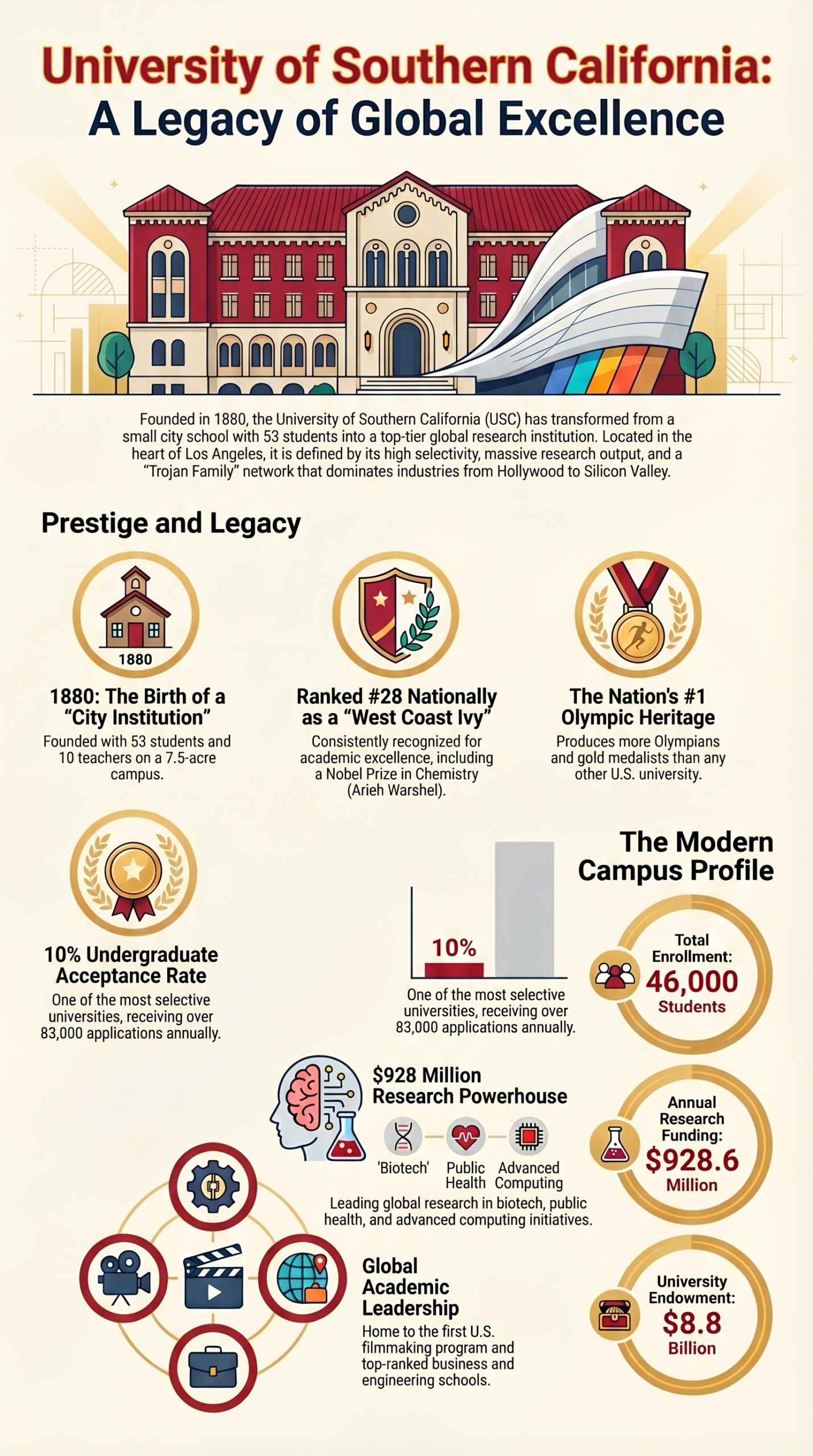

In the 1870s, Los Angeles was a rough-and-tumble frontier town. It lacked paved streets, electric lights, and even a reliable fire alarm system. Yet, it was in this unpolished landscape that a group of public-spirited citizens dreamed of a major center for higher education. When the University of Southern California (USC) finally opened in 1880, it consisted of a single building, 10 teachers, and 53 students who navigated unpaved roads to attend class. The scale of the nascent institution was so intimate that by 1884, the university celebrated a graduating class of just three students.
Today, that small commuter college has transformed into a preeminent global research powerhouse. How did a school that began with three graduates and a handful of dirt lots become an institution that rivals the Ivy League? The answer lies in a century of strategic urban planning, a founding vision of radical inclusion, and an aggressive commitment to a multi-billion-dollar innovation engine.
1. The “West Coast Ivy” Paradox
As we look at the landscape of elite education in 2025, USC’s prestige has reached a level that frequently leads recruiters and families to ask if it is an official member of the Ivy League. While the Ivy League is technically a Northeast athletic conference founded in 1954, USC has earned the moniker of a “New Ivy” or “West Coast Ivy” by embodying a modern, entrepreneurial version of elite education.
The university’s current standing is defined by extreme selectivity and academic rigor:
- Selectivity: For the 2025-2026 academic year, USC received 83,488 applications and admitted just 11.2%.
- National Rankings: Forbes ranks USC at #28 among top colleges, while College Factual places it at #40 out of over 1,700 institutions nationwide.
- Academic Caliber: The middle 50% average unweighted GPA for the incoming class is a near-perfect 3.79–4.00.
“USC offers the academic excellence, prestige, and career outcomes often associated with Ivy League universities. Though it lacks the historical label, its influence and opportunities rival or surpass many Ivy League institutions.”
2. The Great Pedestrian Transformation
Originally, USC was an “urban university organized along the streets of the city,” with traffic and metropolitan noise cutting directly through its academic core. The shift from a neighborhood intersected by traffic to a “pedestrian-oriented campus” was a deliberate strategic choice to create a “jewel” within the city.
The most critical turning point occurred in 1917, when President George F. Bovard ended a decade-long debate about moving the campus to a more secluded area, declaring that USC “should remain a city institution.” This decision necessitated a series of master plans that eventually knitted the campus together into a collection of recognizable “gathering places.” By creating distinct quadrangles—dedicated hubs for Engineering, Cinema, and the Arts—and a campus “heart” at the Doheny Library lawn, USC transformed its physical layout into a strategic asset.
Campus Milestones:
- 1917: The Board of Trustees formally commits to remaining a “city institution,” rejecting a move to the suburbs.
- 1946: The closure of University Avenue to traffic marks the first step toward a cohesive campus feel.
- 1960s: Master plans establish a “ring road” marked by Jacaranda trees and restrict auto traffic in the academic core.
- 1984: In preparation for the Olympic Games, main arteries like Trousdale Parkway and Watt Way are replaced with landscaped plazas, including the now-iconic Hahn Plaza.
3. An Olympic Medal Factory
This physical transformation was not merely aesthetic; it provided the “sense of place” necessary for USC to step onto the global stage. The 1984 Olympic-era renovations prepared the university to host the world, further cementing a legacy that began in 1904 when Emil Breitkreutz became the first Trojan Olympian. Today, the “Spirit of Troy” is a global brand backed by an unmatched athletic heritage.
By the Numbers: USC has produced more Olympians, overall medalists, and gold medalists than any other university in the United States.
This heritage is a cornerstone of the “Trojan Family,” a network of more than 450,000 alumni. From a strategist’s perspective, this is more than a social club; it is a global professional ecosystem. Whether in the C-suites of Silicon Valley or the studios of Hollywood, this network provides the lifelong career outcomes that define the modern “Ivy” experience.
4. A Frontier Vision of Radical Inclusion
Long before diversity became a standard institutional pillar, USC’s founders established a surprisingly progressive mandate. In 1880, the university committed to the principle that “no student is denied admission based on race.”
This vision of radical inclusion was born from a unique interfaith partnership. The land for the university was donated by three prominent citizens of different faiths: Ozro W. Childs (a Protestant), John G. Downey (a Catholic), and Isaias W. Hellman (a Jewish philanthropist).
“The gift provided land for a campus as well as a source of endowment, the seeds of financial support for the nascent institution.” — The Era of the Founders (Referencing the donation of 308 lots)
This founding legacy continues to shape the university’s demographics. In the fall 2025 freshman class, 21% of students are first-generation college attendees, maintaining the 145-year-old promise of accessibility.
5. The $900 Million Innovation Engine
USC has transitioned from a teaching college into a “constellation of schools” leading the way in biotech, AI, and cinematic arts. In the 2024-2025 fiscal year, the university attracted $928.6 million in sponsored research.
Central to this is the $1 billion “Frontiers of Computing” initiative, a massive expansion of AI and advanced computing research integrated across the entire university. This culture of innovation is humanized by faculty like Nobel Prize winner Arieh Warshel. A pioneer in molecular dynamics, Warshel’s work epitomizes the Trojan mindset of aggressive discovery. As he noted regarding his work in modeling biological motors, “many times I solve problems 20 to 30 years before others were able to do it.”
USC Evolution: Then vs. Now
| Category | Evolution (1880 vs. 2025) |
| Student Population | 53 Students (1880) vs. 46,000+ Students (2025) |
| Faculty Strength | 10 Faculty (1880) vs. 4,600+ Faculty (2025) |
| Financial Foundation | 308 Lots of Land (1880) vs. $8.8 Billion Endowment (2025) |
| Operating Scale | Single Building (1880) vs. $7.9 Billion Annual Budget (2025) |
The Trojan Legacy
As USC continues to blur the lines between a private enclave and a city-integrated powerhouse, it remains anchored by a network of 450,000 alumni that includes cultural icons like George Lucas and scientific pioneers like Neil Armstrong. This “Trojan Family” is a lifelong professional ecosystem that serves as the university’s greatest enduring strength.
As USC moves into its next century, its 1917 commitment to being a “city institution” remains its most vital strategic pivot. By refusing to retreat from the urban environment, USC has positioned itself at the center of global innovation, proving that the future of higher education is not found in seclusion, but in the vibrant, diverse heart of the city.