
In the tense months preceding the Supreme Court’s 2023 ruling in Students for Fair Admissions (SFFA) v. Harvard, the warnings from the ivory tower were explicitly dire. In a collective amicus brief, more than 30 leading liberal arts colleges cautioned that a ban on race-conscious admissions could cause Black student enrollment to plummet to just 2.1%—a regression to “early 1960s levels.” When the decision finally arrived, the dissenting justices echoed this alarm, forecasting a “devastating impact” on the racial tapestry of American leadership.
Now that the dust has settled on the 2024 and 2025 admissions cycles, the data suggests a far more complex reality. The predicted doomsday has been replaced by a fundamental architectural shift. Elite higher education is currently undergoing a pivot from race-based to economic-based diversity, a transition that is producing results both counter-intuitive and revealing.
The Diversity “Collapse” Was a Modest Dip, Not a Crater
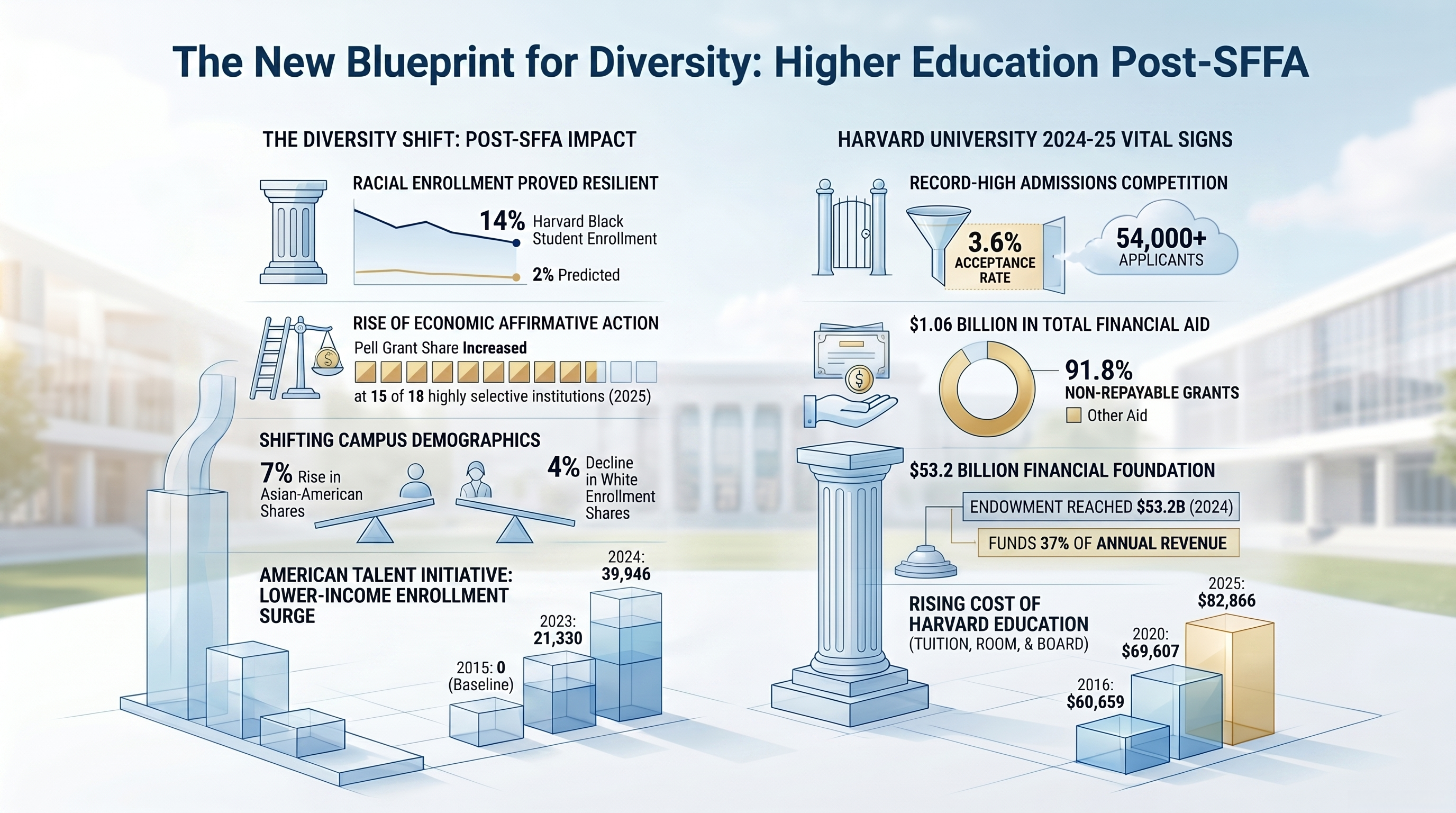
While the SFFA ruling undoubtedly altered the admissions landscape, the “catastrophic collapse” of minority representation has largely failed to materialize. At Harvard College, for instance, the share of Black students did not crater to the feared 2.1%; rather, it fell from 18% to 14%. Remarkably, Hispanic representation at the same institution actually grew by two percentage points, while Asian representation held steady at 37%.
This resilience extends beyond Cambridge. A 2025 College Board report examining 60 selective institutions found that Black enrollment fell by a mere one-tenth of a percentage point—from 7.5% to 7.4%—nationally. As the Progressive Policy Institute (PPI) observed:
“Most (though not all) of the country’s top colleges and universities avoided massive declines, and some saw barely any drop at all… higher education institutions have not given up on diversity. Instead, they have seemingly begun the hard work of finding new paths to it.”
The Meteoric Rise of “Economic Affirmative Action”
With racial identity no longer a standalone factor, Pell Grant eligibility has become the primary lever for campus diversity. This shift is finally addressing what critics have long called an “unfortunate history of virtually ignoring economic class.”
A PPI analysis of 18 highly selective institutions found that 15 of them saw significant increases in their Pell-eligible shares. The scale of this shift is unprecedented: Swarthmore saw a 50% increase, while Boston University experienced a staggering 54.6% surge. Even among the ultra-elite, the pace varies; Yale reported a 22% growth in its Pell share, significantly outstripping Princeton’s still-healthy 8.5% increase.
However, many analysts warn of an “Elite Illusion.” While family income diversity is up, neighborhood diversity (zip code data) remains alarmingly stagnant. National Student Clearinghouse data reveals that between 2023 and 2025, enrollment from the top quintile of neighborhood income actually increased at highly selective colleges. This suggests that while schools are recruiting more low-income students, they are often cherry-picking from high-performing, affluent zip codes rather than reaching into truly distressed communities.
The Harvard Law Paradox: A Resilience Masterclass
Perhaps the most startling data point comes from Harvard Law School (HLS). The institution initially appeared to be a casualty of the new era when Black enrollment dropped from 43 students in 2023 to just 19 in 2024. Critics pointed to this as the first sign of a total institutional retreat.
Yet the 2025 cycle saw a total reversal. Black enrollment at HLS soared to 50 students, representing 8.6% of the class—a share actually higher than when racial preferences were legally permitted. This “rollercoaster” suggests that graduate programs may be more adept at navigating the “personal essay loophole” mentioned in the SFFA ruling. By evaluating how racial identity has shaped an individual’s perseverance or grit, law schools are finding ways to maintain diversity through race-neutral tools that prioritize lived experience over categorical labels.
The $53 Billion Question: Endowment vs. Public Interest
As elite institutions pivot their admissions strategies, they do so from a position of overwhelming financial power. This has intensified the focus on the “sticks and carrots” that policymakers might use to align these institutions with the public interest.
Harvard’s Financial Footprint: FY2024-25
| Category | Value |
| Harvard College Total Tuition, Room, Board & Fees (FY25) | $82,866 |
| University-Wide Total Financial Aid Awarded (FY24) | $1.06 Billion |
| Total University Endowment Value (FY24) | $53.2 Billion |
Policy proposals are now circulating that would tie the existing endowment tax to institutional performance. Rather than a flat rate, PPI suggests adjusting the tax upward for “bad actors” who fail to improve social mobility and downward for “good actors” who do. Furthermore, there is a bipartisan push to eliminate “Legacy Preferences”—frequently described as “affirmative action for the wealthy”—which provides a significant admissions boost to the children of alumni, most of whom are white and affluent.
The Wealth Gap: The Next Frontier for Admissions
While the current focus on Pell Grants (income) is a start, it remains an incomplete metric of disadvantage. There is a profound distinction between annual income and household net worth. In the United States, Black households earn roughly 60% of the income of white households but hold only 10% of the wealth.
Wealth captures the intergenerational impact of historical obstacles—such as redlining and segregation—in a way that annual income cannot. Middle-income Black families often live in higher-poverty neighborhoods than low-income whites, meaning their children often face more significant environmental hurdles despite their parents’ salaries. To create a truly fair system, admissions officers must eventually look past the Pell Grant and toward family net worth to identify talent that has truly overcome adversity.
Toward an “Aristocracy of Talent”
The post-SFFA landscape is not a defeat for diversity; it is an evolution toward a class-based system. By shifting the focus from racial identity to economic hurdles, elite institutions are beginning to approximate Thomas Jefferson’s vision of a “true aristocracy of talent and virtue” rather than one of “wealth and birth.”
But the question of institutional sustainability remains: If elite colleges can maintain—or even expand—diversity by focusing on economic hurdles, does this represent a more sustainable path for American social cohesion? Or is the persistent reliance on high-income zip codes proof that the “Aristocracy of Talent” is merely a rebranded “Aristocracy of Wealth”? The coming years will determine whether these changes are a genuine step toward social mobility or just a new way to mask the same old inequalities.