1. Introduction: The Frontier of Higher Ed
In his 2025 inauguration address, President Jonathan Levin framed Stanford as “the university of the American frontier.” It is a bold, evocative metaphor for an institution that sits at the epicenter of global innovation, yet the reality of maintaining that frontier status has never been more complex. Today, Stanford is navigating a period of profound transition, attempting to balance its leadership in the AI revolution with the management of a multi-billion-dollar healthcare empire—all while undergoing an internal cultural reckoning.
To understand the trajectory of this 130-year-old powerhouse, one must look beyond the sandstone arches and into the data. Behind the ivy-covered walls, the university is deploying “synthetic brains” to fight disease and rethinking its very administrative DNA. From the financial reality of the “hospital that teaches” to the strategic repair of its campus climate, here are five surprising truths behind Stanford’s current evolution.
2. The AI “Black Box” and Synthetic Brains
Stanford is leading a fundamental paradigm shift in artificial intelligence: moving from AI as a mere tool to AI as a subject of physics-based inquiry. While the public focus remains on generative chatbots, Stanford researchers are treating AI learning dynamics as a physical system to understand why these models work.
A primary example of this “Frontier” leadership is the university’s work in Advancing Data-Driven Discovery. Researchers are currently using generative AI to solve the “data scarcity” problem in medical science by transforming 100 real brain MRIs into 5,000 synthetic ones. This shift from observational science to generative simulation allows for the training of diagnostic models at a speed and diversity previously thought impossible.
This spirit of discovery is codified in the “Physics of Learning and Neural Computation” project, led by Surya Ganguli, which seeks to “unlock the black box” of neural networks. For students, this evolution isn’t limited to the lab; the AIMES (AI Meets Education at Stanford) initiative is now integrating these generative affordances directly into undergraduate pedagogy. This aligns with President Levin’s “North Star”: a fundamental purpose of discovery and learning where technology serves to “prepare students to be curious and think critically.”
3. The Healthcare Giant Hiding in the University
The most startling revelation in the Fiscal Year 2025 financial results is the composition of Stanford’s revenue. While the public associates Stanford with tuition and research, the institution has effectively become a healthcare conglomerate that hosts a world-class academic campus on the side.
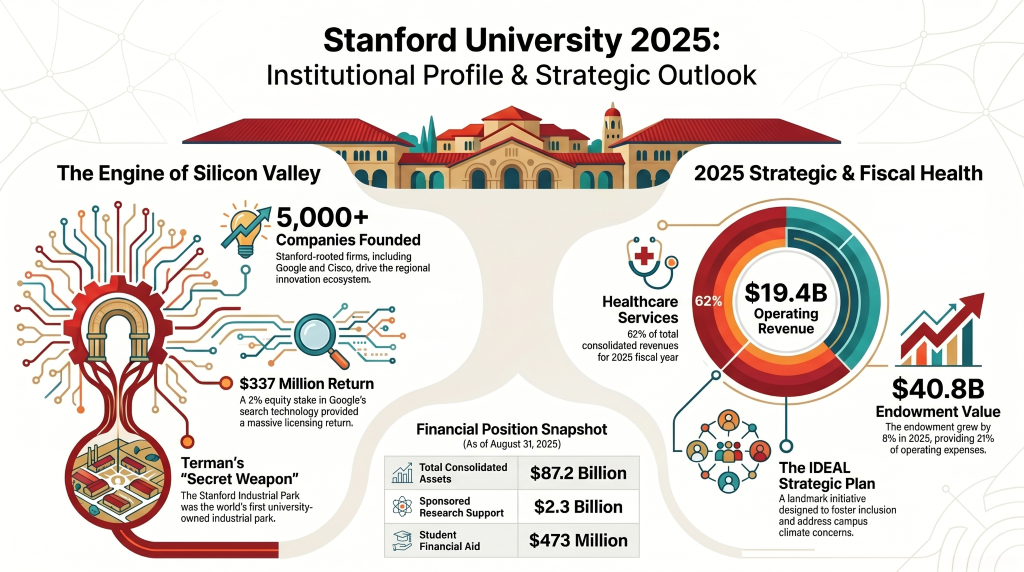
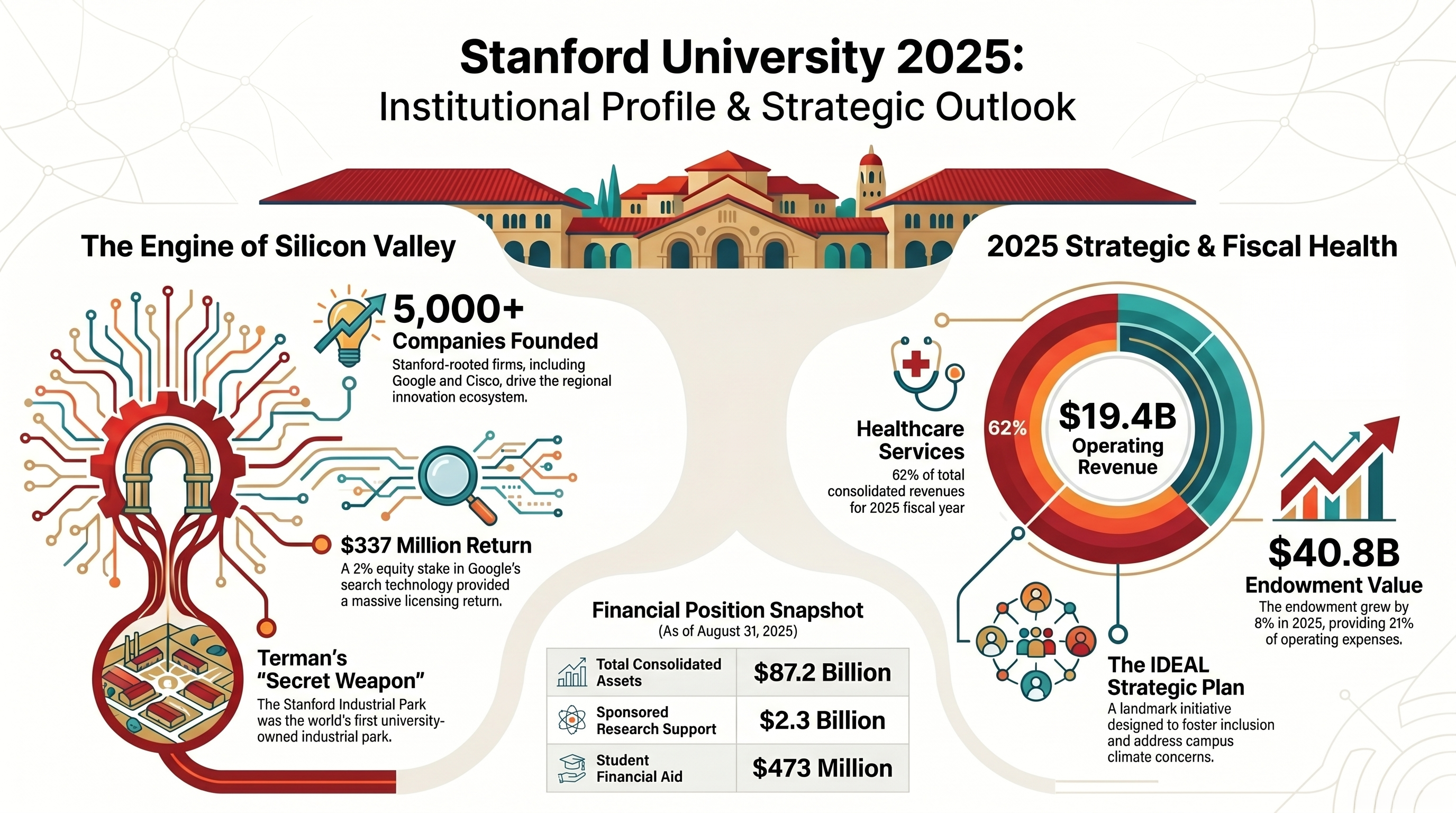
Health Care Services—comprising Stanford Health Care (SHC) and the Lucile Salter Packard Children’s Hospital (LPCH)—now account for a staggering 62% of the university’s total consolidated operating revenues, totaling $12.1 billion. In sharp contrast, the “University” (the academic core) reported a $78 million decrease in net assets from operations this year.
This creates a counter-intuitive reality: the “University of the American Frontier” is technically operating its academic mission at a loss, kept solvent by its massive healthcare wing. This “Hospital that Teaches” model places immense pressure on the academic side to find efficiencies, as it faces challenges from lower indirect cost recovery and reductions in federal research funding.
4. A “North Star” for Cultural Repair
While Stanford’s external research output is at an all-time high, internal data from the IDEAL (Inclusion, Diversity, Equity, and Access) initiative suggests a critical need for cultural repair. The 2021 Climate Survey revealed sobering truths: one-third of the nearly 15,000 respondents faced significant impacts from microaggressions or harassment.
From an analyst’s perspective, the IDEAL framework is more than a DEI initiative; it is an essential retention strategy for institutional excellence. The survey found that 23% of respondents—a massive “flight risk”—had seriously considered leaving Stanford due to the campus climate. To counter this, programs like ePluribus Stanford were launched to bolster civic engagement and constructive dialogue.
As Shirley Everett, Senior Advisor to the Provost, noted, the goal is an ecosystem where “social identity will no longer be a factor in the assessment of merit.” For Stanford, creating an environment where a fifth of the population doesn’t want to quit is not just a moral imperative—it is a survival requirement for its research mission.
5. The “Secret Weapon” of the Silicon Valley Legacy
Stanford’s dominance in Silicon Valley was never a result of “fortunate happenstance.” It was a deliberate, defensive “endogenous strategy” created to prevent California from being a “colonial” outpost for Eastern economic interests.
The primary architect was Frederick Terman, the former Provost and “one-man incubator.” His “secret weapon” was the Stanford Industrial Park—the first university-owned park in the world. However, the park’s existence was actually born from a legal constraint: Leland Stanford’s will strictly prohibited the sale of the university’s land. Terman turned this restriction into a masterstroke by leasing the land to high-tech companies like Varian Associates and Hewlett-Packard.
By keeping the land and the industry anchored to the campus, Terman ensured that academic knowledge would be the direct source of firm formation. This legacy of technology transfer continues to pay off; for instance, the university’s Office of Technology Licensing famously turned a 2% equity stake in a student project called Google into a $337 million windfall.
6. Radical Agility: The “Simplify Work” Movement
As the university swells into a $19.4 billion entity, it is struggling with the “weight” of its own complexity. The $78 million deficit in the academic core has made the “Simplify Work” movement a fiscal necessity rather than a mere administrative preference.
The movement toward “radical agility” involves decentralizing power, such as empowering individual schools to handle their own faculty appointments and promotions to reduce administrative friction. The streamlining efforts extend deep into the bureaucracy, including overhauling research contract agreements and updating travel procedures to ensure compliance with the Fly America Act without unnecessary red tape.
However, this push for agility comes with the friction of transition. In July, the university implemented staff reductions to address rising compensation costs and economic uncertainties. The current strategy is a high-stakes attempt to trim the administrative sails, ensuring that every available dollar is redirected back into the core missions of research, education, and healthcare.
7. Conclusion: The Future of the Frontier
Stanford stands at a crossroads, navigating a period defined by both “challenge and change.” Its path forward is a cohesive, if difficult, strategy: doubling down on AI leadership through initiatives like AIMES and the Physics of Learning, leveraging its massive healthcare revenues to shield its academic mission, and pursuing cultural transparency via the IDEAL framework.
The university remains a pioneer, but the nature of the frontier has shifted. It is no longer just about the physical land of the West or the digital land of the internet; it is about the internal frontier of institutional efficiency and cultural equity.
In an era where technology moves faster than policy, can a 130-year-old institution truly remain “the frontier,” or is the weight of its own complexity its biggest hurdle?