In November 1842, a 28-year-old French priest named Rev. Edward Sorin, C.S.C., arrived in the frozen Indiana wilderness with seven companions and just $310 to establish a college on 524 snow-covered acres. Today, that fledgling outpost has transformed into a $20 billion global academic powerhouse ranked as the top Catholic university in the United States. Below is a curated exploration of the most surprising and pivotal moments that forged the history, resilience, and unique culture of the University of Notre Dame.
From Ashes to Gold: The 1879 Fire and an Audacious Rebuild
On April 23, 1879, a disastrous fire swept through the Notre Dame campus, completely destroying the original college building in just three hours. Returning to the smoldering ruins, the school’s 65-year-old founder, Father Edward Sorin, defied the destruction. Rather than viewing the blaze as a fatal tragedy, he saw it as a divine mandate to rebuild on a far grander scale:
“I came here as a young man and dreamed of building a great university in honor of Our Lady. But I built it too small, and she had to burn it to the ground to make the point. So, tomorrow, as soon as the bricks cool, we will rebuild it, bigger and better than ever.”
Driven by this audacious vision, 300 laborers worked 16-hour days through the summer, laying 4.3 million bricks to rebuild the Main Building in time to reopen for classes that fall. When construction reached the summit, they erected a taller, wider dome and gilded it in real gold leaf, creating the university’s most iconic landmark. This relentless turnaround forged a culture of optimism and resilience that continues to define the institution’s identity today.
Defying the Hoods: The 1924 South Bend Klan Clash
During a period of rising nativist anti-Catholic prejudice in the 1920s, the Ku Klux Klan targeted South Bend—the most heavily Catholic region in Indiana, a state then suffering from a surging Klan presence. In May 1924, when the KKK attempted to hold a massive week-long rally downtown, approximately 500 Notre Dame students took matters into their own hands. Students swarmed downtown, brawling with Klansmen, ripping off their hoods and robes, and confiscating their regalia.
Order was restored only after University President Rev. Matthew Walsh, C.S.C., ordered the students back to campus and legendary football coach Knute Rockne implored them at a rally to refrain from further violence. Three years later, in 1927, Father Walsh officially approved the nickname “Fighting Irish” to replace more derisive monikers of the era. By confronting religious bias directly—both through campus activism and athletic competition—Notre Dame built a shield against discrimination and galvanized a passionate nationwide support network known to this day as “subway alumni.”
How the U.S. Navy Saved the University from Collapse
World War II posed an existential financial threat to Notre Dame as young civilian men left campus to enlist, causing enrollment to plummet. To keep the university solvent, leadership reached out to Admiral Chester Nimitz, offering campus facilities to the military. The U.S. Navy accepted, transforming the academic grounds into a virtual military base hosting the V-7 Navy College Training Program, which trained approximately 12,000 naval officers during the conflict.
In a striking historical irony, this Catholic religious institution relied on a massive military partnership for its financial survival during a national crisis. This vital wartime collaboration cemented an enduring relationship with national service, famously encapsulated in the campus motto carved above the Basilica’s War Memorial entrance: “God, Country, Notre Dame.”
Outperforming the Ivies in Value, Graduation Rates, and Access
In the modern academic landscape, Notre Dame pairs elite selectivity and research stature with exceptional student outcomes and unprecedented financial accessibility:
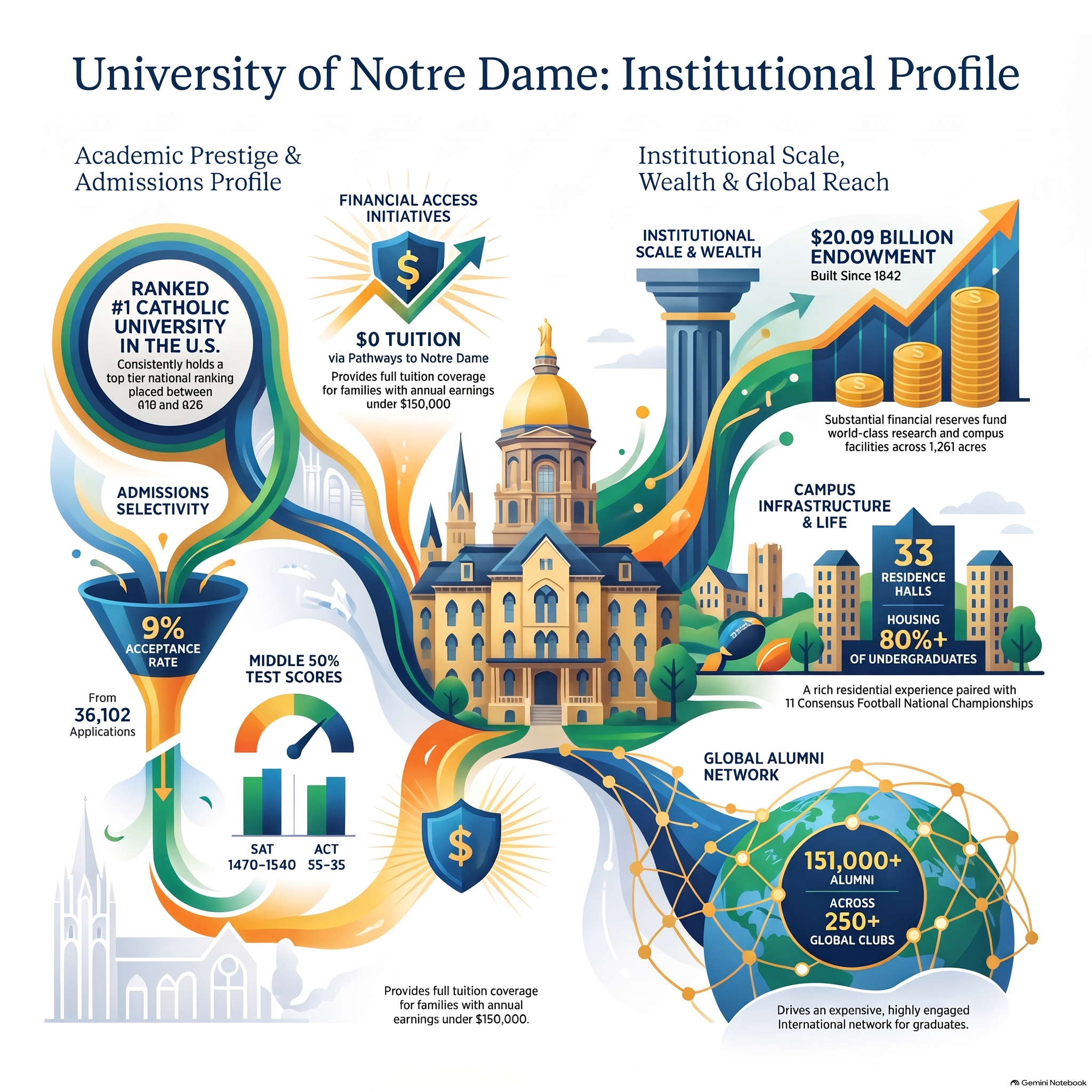
- #1 Catholic University in the U.S.: Notre Dame stands as the nation’s premier Catholic university and consistently ranks among the top 20 national universities overall (#18–#20).
- 97% Graduation Rate & High ROI: The institution achieves a stellar 97% graduation rate, paired with a $546,000 20-year net return on investment (ROI) for its graduates.
- AAU Member: In 2023, Notre Dame became the only Catholic university invited to join the prestigious Association of American Universities (AAU), an elite consortium of North America’s leading research institutions.
- Financial Accessibility via “Pathways to Notre Dame”: The university meets 100% of demonstrated financial need for admitted undergraduates. Under this initiative, Notre Dame covers half-tuition for families earning under $200,000 per year; full tuition for families earning under $150,000; and full tuition, fees, room, and board for families earning under $60,000.
Uniquely Intense Campus Traditions
Student life at Notre Dame is anchored by immersive residential structures, visual landmarks, and athletic traditions unmatched across higher education:
- Full-Contact Interhall Football: Notre Dame hosts the only non-military academy full-contact intramural tackle football program in the United States, where residence hall teams battle through the autumn, culminating in a championship game inside Notre Dame Stadium.
- 33 Single-Sex Residence Halls: Undergraduates reside in vibrant, non-Greek dormitories managed by live-in professional rectors—priests, religious sisters, or trained lay ministers—who foster deep communal bonds, supervise hall staff, and oversee dedicated hall chapels.
- “Touchdown Jesus” Mural: High atop the exterior of the 14-story Hesburgh Library stands the famous Word of Life mosaic mural designed by artist Millard Sheets. Overlooking Notre Dame Stadium, the mural depicts Christ with raised arms, earning its beloved nickname as he appears to signal a touchdown over the arena.
These deep-seated residential and athletic traditions cultivate an unusually tight-knit communal identity among students and alumni that endures long past graduation.
The Legacy and Future of Our Lady’s University
From a frozen, $310 mission in 1842 to an elite global research institution, Notre Dame’s evolution demonstrates a remarkable ability to turn existential trials into foundational strengths. Through devastating fires, anti-Catholic hostility, and wartime enrollment collapses, the university forged a distinct identity centered on faith, academic rigor, and intense communal tradition. As higher education institutions look toward an uncertain future, how can modern universities balance a commitment to deep historical traditions with the demands of rapid academic and financial progress?