The popular image of the Massachusetts Institute of Technology (MIT) is a persistent caricature: a sterile, logic-driven fortress of “genius engineers” tucked away behind the neoclassical pillars of the Great Dome. Most people see a world of robots, math, and the sterile whiteness of the Infinite Corridor—the nearly 900-foot-long hallway that serves as the Institute’s spine. Yet, the data reveals a far more human, and sometimes radical, reality.
Beyond the machinery, MIT is an institution defined by a fierce independent streak and a culture that values creative workarounds as much as formal proof. To understand the modern Institute, one must look past the blackboard at the surprising truths revealed by its latest institutional data and storied history.
1. The “People, Not Numbers” Paradox
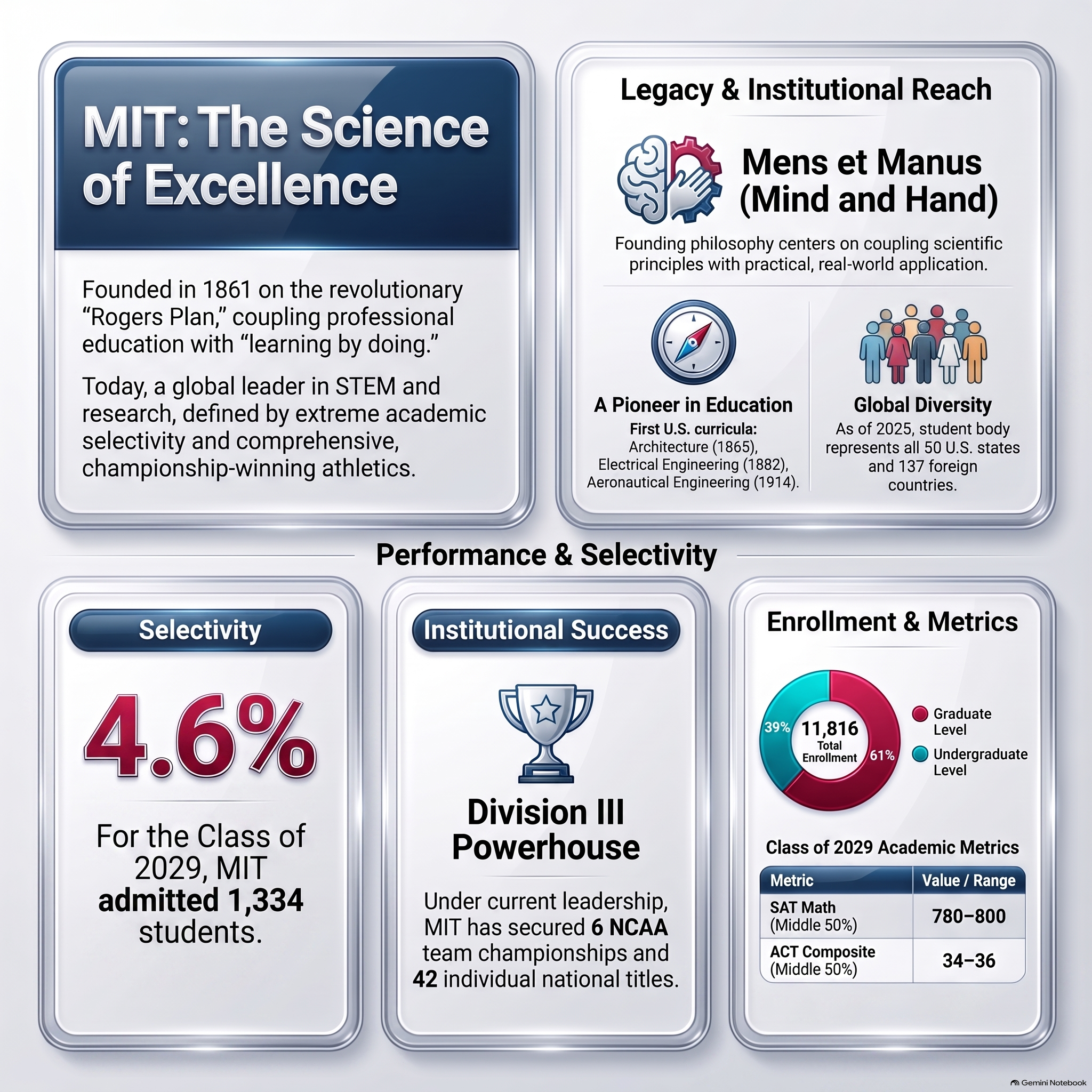
On paper, the admissions statistics for the Class of 2029 are nothing short of intimidating. With a razor-thin 4.6% admit rate and a middle 50% SAT Math score range of 780–800, the quantitative bar for entry is effectively the ceiling of standardized testing. However, for the admissions office, these metrics are merely the “entry fee” for a much deeper evaluation.
MIT utilizes a “holistic admissions” philosophy that searches for a specific qualitative “match” rather than the highest score. As the admissions office emphasizes:
“At MIT we admit people, not numbers.”
This creates a unique paradox: while the quantitative bar is the highest in the world, the final decision rests on human characteristics that cannot be graphed. In this culture, perfect scores are common, but they are considered secondary to the applicant’s humanity and their potential to use science and technology to serve the world.
2. The School That Refused to Become Harvard
While MIT and Harvard now share a cooperative neighborly bond, their history is defined by an existential battle for the soul of “Boston Tech.” For decades, the younger, more practical Institute fought to avoid being absorbed by its older, “classical” Ivy League neighbor.
The independence of the Institute was forged through a stubborn refusal to be consolidated. There were at least six failed attempts to merge MIT into Harvard over the years. A major arrangement in 1917 was poised to finally combine departments, but the move was ultimately cancelled by a State Judicial Court decision. This legal intervention allowed MIT to maintain its radical “learning by doing” identity, proving that the Institute valued its unique mission more than the inherited prestige of a merger.
3. The Unlikely Athletic Powerhouse
Perhaps the most counter-intuitive reality of the campus is its status as a Division III athletic juggernaut. Under the leadership of Dr. G. Anthony Grant, the Department of Athletics, Physical Education and Recreation (DAPER) manages one of the most comprehensive programs in the nation, supporting 33 intercollegiate teams and over 800 student-athletes.
In the 2024–25 season, the women’s program achieved a historic first for a Division III school by sweeping all three NCAA National Championships—Cross Country, Indoor Track, and Outdoor Track—in a single year. These were the first MIT women’s national titles in those specific programs. This dominance is driven by the “Engineer-Athlete” culture and a $5 million renovation to the Sports Performance Center, reflecting a “Shared Purpose” where the discipline of the field is seen as a vital extension of the rigor of the lab.
4. The Graduate-Student Majority
Many envision MIT as a traditional college town teeming with undergraduates, but the October 2025 enrollment statistics tell a different story. MIT is primarily a “working lab,” dominated by its graduate population.
Of the 11,816 total students, graduate students make up 61% (7,255 students), while undergraduates account for only 39% (4,561 students). This tilt creates an atmosphere of professional research rather than standard collegiate life. This population is also intensely global; students hail from 137 countries, and 41% of the entire graduate body is international. On the MIT campus, the pursuit of new knowledge is a 24-hour, multi-national operation.
5. A History of Radical Non-Conformity
MIT’s culture is underpinned by a strain of anti-authoritarianism that has occasionally placed it on the front lines of political conflict. During the 1960s and 70s, the campus was so active in its opposition to military-related research that the Institute eventually had more names on President Nixon’s “enemies list” than any other single organization. This included figures like then-President Jerome Wiesner and Professor Noam Chomsky. Nixon famously ordered federal subsidies to be cut in retaliation for Wiesner’s “anti-defense bias.”
This spirit of non-conformity is best expressed in the “Hidden Curriculum.” In 1970, Dean Benson R. Snyder identified the use of “Course Bibles”—informally compiled archives of problem sets and solutions. While students viewed these as creative “hacker” workarounds to navigate an overwhelming workload, Snyder offered a more analytical critique: he argued they were “counterproductive” because they created a feedback loop error, fooling professors into believing they were imparting broad knowledge when students were actually just learning to master the system.
6. The Alumni Spectrum: From Peacemakers to “Lady al-Qaeda”
The MIT alumni network provides a startling look at the spectrum of global influence. Because the Institute famously never awards honorary degrees, every individual on the alumni list—regardless of their eventual legacy—earned their place through academic achievement.
The diversity of this spectrum is immense:
* Kofi Annan (M.S. in Management, 1972): Former Secretary-General of the United Nations and Nobel Peace Prize recipient.
* Benjamin Netanyahu (B.S. in Architecture, M.S. in Management): The Prime Minister of Israel.
* Mario Draghi (PhD in Economics, 1977): Former Prime Minister of Italy and former President of the European Central Bank.
* Aafia Siddiqui (B.S. in Biology): The Pakistani neuroscientist known as “Lady al-Qaeda,” currently serving an 86-year sentence in the U.S. for attempted murder and other felonies.
This list proves that while MIT provides the technical and analytical tools for world-changing influence, the ethical direction of that power remains entirely in the hands of the graduate.
Conclusion: The Constant State of “Learning by Doing”
MIT remains a place governed by high-stakes data, but its soul is found in the Mens et Manus (Mind and Hand) philosophy. It is an institution that chose independence over the Ivy League, values the “Engineer-Athlete” as much as the researcher, and fosters a culture of radical skepticism toward authority.
If the world’s leading technical institute prioritizes “match” and “culture” over perfect test scores, what does that tell us about the future of human potential? In an increasingly technology-driven world, MIT’s willingness to be “different”—and its refusal to be defined by numbers alone—may be its most important contribution to the 21st century.